Since 1986, Relocation Strategies has been helping organizations relocate and reconfigure their workspaces. Over the years, we’ve evolved and now help companies reimagine their workplaces to fit the current needs of their staff with the help of our proprietary Workplace Productivity Analysis® and our team’s space planning and interior design expertise.  

This year, we’re celebrating 35 years in business! Help us celebrate this incredible milestone by learning more about our history and accomplishments:

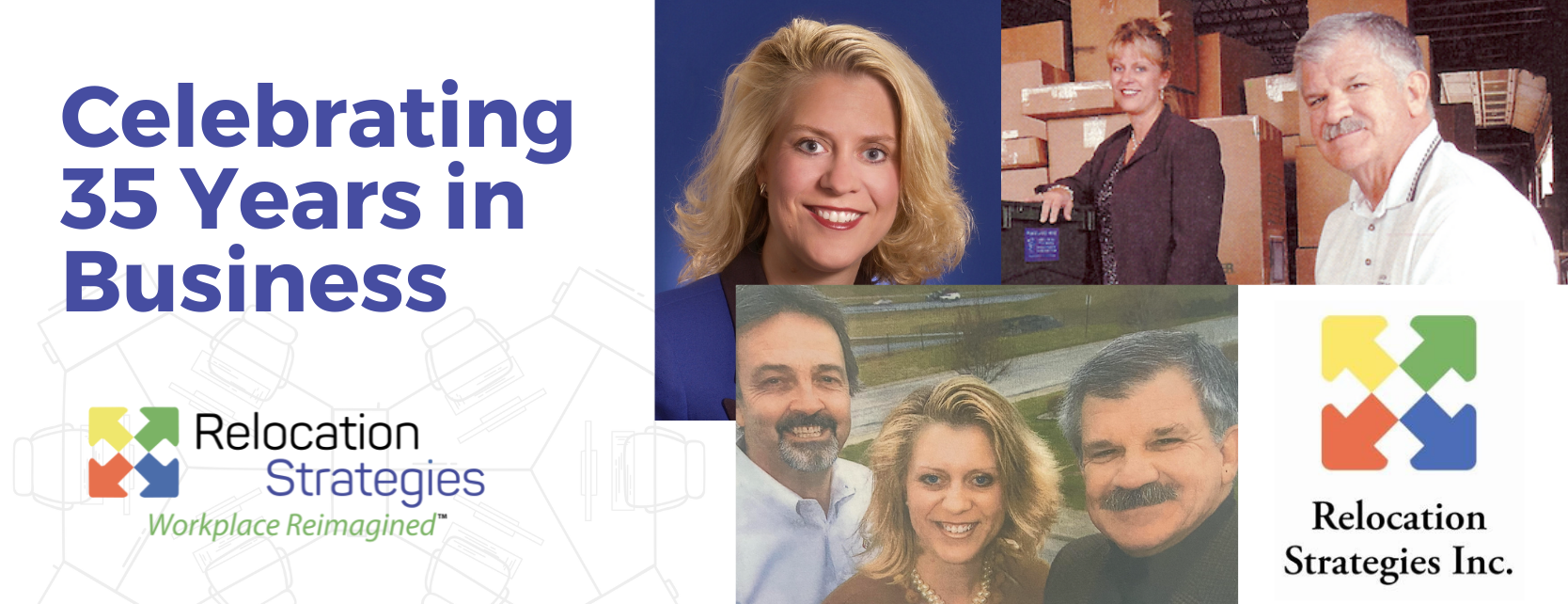
35. Founded 35 years ago by David Bayse

Relocation Strategies would not be here without retired founder David Bayse. David’s relationship building skills and knowledge of the moving industry helped the company build an impressive client roster and expand into other areas of commercial real estate, including office furniture procurement. 

On November 1, 2007*, I purchased the company after being mentored under David for two years. I’m so incredibly grateful to David for his support. 

*According to Fast Company Magazine, this was the first reported day of the recession.
34. Our loyal clients and partners

Throughout the years, we’ve developed some amazing relationships with clients and partners. Each and every one of you have shaped Relo in interesting and unexpected ways.  

Thank you to our loyal clients and partners for their unwavering partnership. We appreciate you more than you know. 

33. Locally owned and operated

Since the company was founded, Relocation Strategies has been locally owned and operated. We’re a proud Hoosier company that helps other organizations in Indiana and across the country reimagine and relocate their businesses. 

32. Our office 

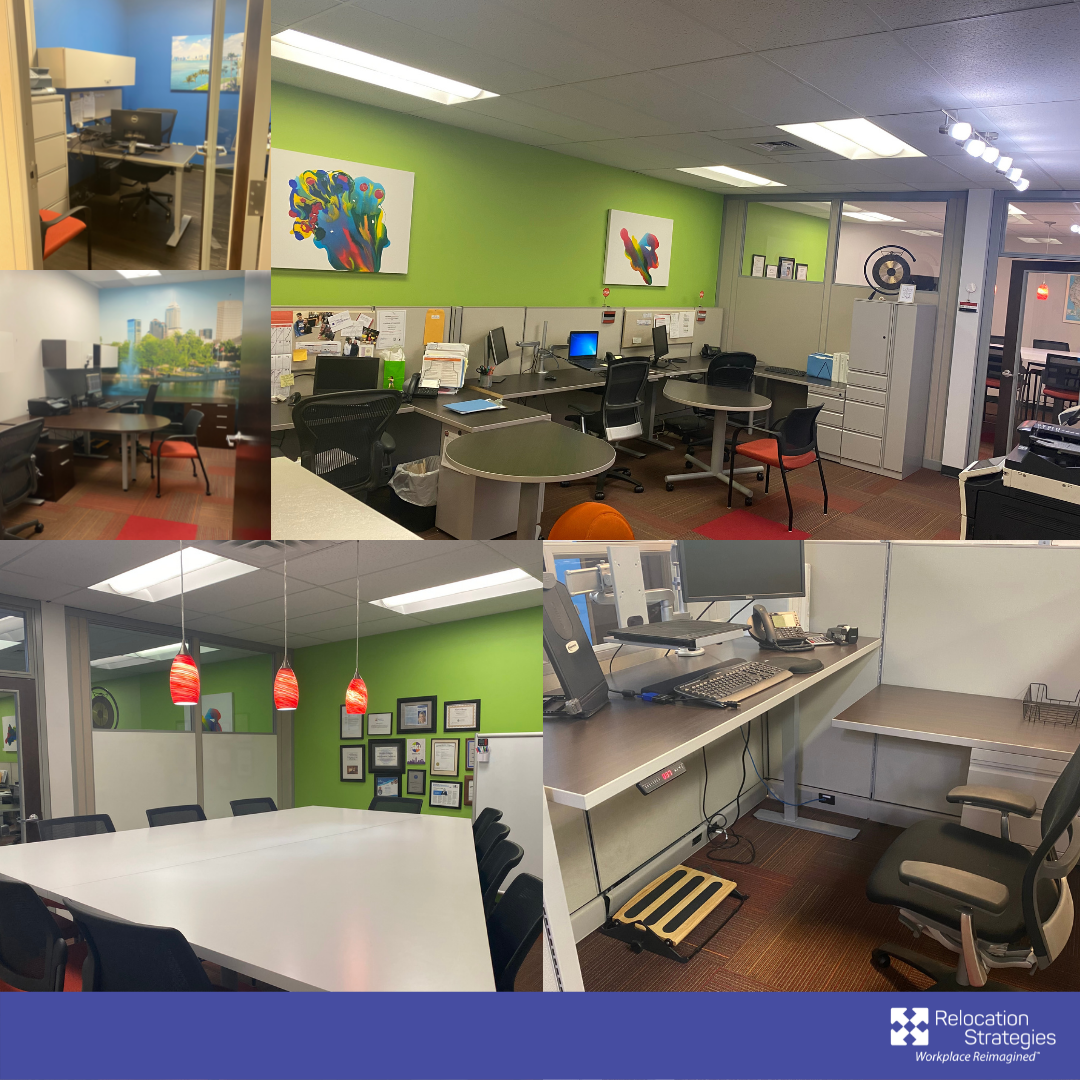
We practice what we preach! As a space planning and interior design company, it was important to us that our office reflected the needs and value of our organization. We love our engaging space located just off Binford. Check it out:
31. Our team and our fearless leader

We wouldn’t be what we are today without our people. Our staff has over 120 years of experience working within the design, furniture, and project management fields. Each and every one of our staff members are passionate about helping our clients navigate workplace transitions. Thank you for your dedication to our clients and their success!

30. Furniture + Vendor Management

When I joined Relo in 2004, I brought over 15 years of my expertise in furniture and vendor management to the business. As a natural extension of relocation, we were able to expand our offerings with this expertise and help our clients in new ways.

Relocation Strategies helps save time and money with furniture and vendor management. We are vendor-neutral when it comes to furniture procurement and pride ourselves as being a Net Zero cost to clients with the savings we provide. We also developed our proprietary I.D.E.A.™ software which helps document and manage inventory for moves or relocations.

29. Space Planning and Interior Design

Space planning and interior design is essential for employee engagement; we are passionate about helping organizations make workspace changes that meet the current and future needs of their staff. This includes determining square footage needs, reconfiguration of work stations, occupancy verification, renovation coordination, artwork coordination, and more.

28. MCM

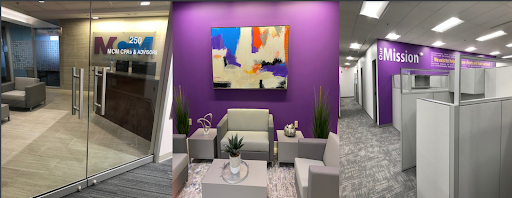
Being newer to Indianapolis, MCM was looking for a new location and home that would reflect their brand and culture, as well as, be convenient and productive for clients and staff. We were thrilled to help them with space planning, design, and construction drawings to create their new space. See the full case study here.
27. IU Health

Over the years, we have worked on a lot of IU Health projects across multiple campuses and a total of 350,000 square feet. Leveraging our expertise with furniture inventory and optimization, move management, and space planning and interior design, Relocation Strategies successfully reimagined IU Health workplaces. Take a look at the case study.

26. Patent-Pending ReloShields

When the pandemic hit, no one knew how to safely bring people back to the office. As a way to help add an extra layer of protection, we developed ReloShields, affordable, recyclable, temporary, and easy to install workspace shields, to help keep employees and teams safe when returning to the office. Since March of 2020, many different organizations have purchased ReloShields, made locally, in bulk to help protect their staff. Check out all of our ReloShields here.

25. Monarch Distributing

When it was time to relocate 650 employees for Monarch Beverage, we had to determine new furniture needs, as well as, coordinate the move around the annual NASCAR Sprint Cup Points Race (one of Monarch’s busiest weekends). We worked together to phase the move over four weekends and inventory/assess all existing furniture for possible reuse. We were able to successfully move Monarch with minimal downtime and reuse 70% of their existing furniture, saving them time and money. See the full case study here.

24. Gilchrist & Soames

Gilchrist & Soames came to us needing the coordination of a lab move with production and filling lines and a warehouse move including over 7,000 skids and 3,000 critical skids. It required precise coordination of move phases that aligned with the production schedule. 

Working closely with their team, we completed the move in two phases that allowed Gilchrist to keep their production schedule. We also coordinated crews for lab tear-down, move, and reinstall. The project was a complete success! See the full case study here.

23. ICE Miller

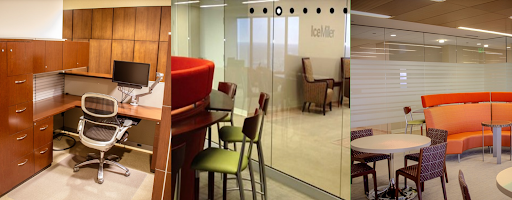
When it was time to renovate a 25-year-old occupied space for Ice Miller, our focus was to minimize disruption, loss of productivity and lost income during renovation and shuffle. Together, we were able to move 500 when they reduced tower space from nine floors to seven floors, consolidated libraries and implemented record initiatives to reduce paper, and inventoried furniture assets and conditions. Not to mention discovering a $300,000 on previous furniture bids. See the full case study here.
22. Citizens Energy

We’ve worked with Citizens Energy Group over the past 10 years to move over 1000 staff. In 2011, we managed a rolling renovation with over 40+ phased weekends, determined temporary staging for departments during construction, and coordinated two different furniture vendors and labor crews for moves. Project management has been crucial in all projects. See the full case study here

21. IPL (AES)

Indianapolis Power & Light (IPL), an AES company, had employees occupying half of the circle building during a 10-floor renovation. IPL needed to coordinate 300 employee moves over three phases and move 10 floors of furniture prior to construction. 

To complete the project, we:

  • Worked with their team to inventory furniture and provide asset list to facilities
  • Coordinated and moved 150 employees to an offsite temporary space 
  • Moved all employees to the final destination of five floors
  • Cleared floors of furniture prior to construction which included coordination of a semi-trailer of donated items to Goodwill, two semi-trailers for reuse to Petersburg plant, and two straight trucks to Morris Street location
  • Property disposed of/recycled items unable to be reused

See the full case study here. 

20. IBJ

When it was time to make a move, the Indianapolis Business Journal (IBJ) worked with Relocation Strategies to help plan their move into 15% less square footage to maximize their space, after completing our Workplace Productivity Analysis® to determine square footage needs and build workstations that are productive and engaging. 

Watch the testimonial from Kim Howell below to learn more about the project.

19. Raising Employee Engagement and Productivity

When working with any client, our goal is to design engaging and functional workspaces so organizations can increase employee engagement and productivity. After engaging with Relocation Strategies, the majority of our clients state their employee engagement and productivity increased by more than 25%.

18. Wilhelm Construction

Wilhelm Construction knew their current environment provided no room for growth and they needed a more collaborative environment to attract and retain a more diverse workforce. To meet their needs, Relocation Strategies performed a Workplace Productivity Analysis® to better understand how the space needed to function. We were able to reallocate space and furniture to create a more user-friendly environment to foster collaboration. We added two additional offices and 12 workstations while reusing 5-year-old cubicles to save $400,000 to purchase new ones. See the full case study here

17. Indianapolis Airport

After their existing building was sold, the Indianapolis Airport Authority (IAA) needed help with a large-scale, two-phase personnel move over a four-day weekend. Furniture and remaining assets had to be moved in four phases over the course of six months, along with being inventoried, palletized, relocated, and prepped for auction. Plus, security was top of mind for each piece of the process. 

Relo managed the relocation and ensured all vendors were following protocol, and we saved the IAA 50% on move services and 10% on furniture purchase due to product optimization. See the results in our case study.

16. Indianapolis Chamber

Relocation Strategies led the charge for reimagining the Indy Chamber’s 14-year-old workplace. We helped them create a collaborative, productive, and updated environment to meet and work. At the beginning of the project, the challenge was to keep staff productive during a four-phase renovation and create a budget for renovation while being mindful to reuse existing private office furniture. We inventoried all of the existing furniture with our proprietary I.D.E.A.® software to determine what needed to stay and what new furniture would blend well with the existing. Take a look at the result

15. Community involvement

Giving back to the community is incredibly important to Relocation Strategies. We’ve helped a variety of organizations like the Girl Scouts, Hard Hats for Hearts, Dress for Success, and more. See the full list here

14. Foster Success

Foster Success wanted to safely and cost-effectively bring their employees back to the office so they could continue providing critical services to foster care teens and young adults. We were thrilled to help provide them with custom #ReloShields that were sized specifically for their desks. Thanks so much to the United Way of Central Indiana for the introduction!

13. WBE Certified

We are proud to be WBE certified at the city, state, and national level. As a woman business owner, I am passionate about supporting other woman-owned businesses and frequently hire women-led businesses as partners or vendors.

12. Workplace Productivity Analysis ®

Relocation Strategies uses our proprietary Workplace Productivity Analysis® to increase engagement and productivity. This survey gives employees a protected voice as we find and implement the right workspace changes for our clients. Not only does the entire staff complete our survey with custom-designed questions, but we also hold a series of one-on-one meetings with department heads and stakeholders to understand budgetary and logistical concerns. Our consultants and designers pair survey results, stakeholder information and extensive industry knowledge to make our recommendations. 

Our clients say this is one of the greatest tools in our toolbox, and we’ve administered it to over 5,000 employees and assisted 4 global firms since 2011 to increase employee engagement and productivity by 25%. 

11. Stanley Security

Due to reusing a majority of existing furniture, Stanley Security Solutions employee moves were dependent on the existing furniture being available. This was a logistics puzzle to plan each department to move together and minimize down-time. By the end of the project, we helped them save over a million dollars and integrated eight different furniture system styles from four different buildings into one new building. See what they had to say about the results.

 10. Saved Clients Millions of Dollars

Do you know when companies need to relocate their workforce in their same buildings or to new ones, that furniture has two impacts: cost and productivity?  We provide solutions that increase employee productivity by 25% and reduce furniture expenses through our proprietary methods. We helped Citizens Energy, Duke Realty, Community Justice Center, IU, IU Health, Purdue, the Indianapolis Chamber of Commerce, Stanley Security and Wilhelm Construction save (collectively) over $25 million in furniture costs and increase productivity outcomes using our proprietary I.D.E.A.™ software. When the client wins, so do we. We always celebrate when we can save clients money, time and resources!

9. I.D.E.A.® Custom Inventory Software

Because of the immense savings, we are very proud of our proprietary I.D.E.A.® software (Inventory Database Equipment Access). Designed and is owned by Relo, I.D.E.A.® captures photos, quantities, sizes, and manufacturers for furniture, as well as, assigns a grade for the condition for suggested reuse (or not). Learn more about it here.

8. Pacers + Shiel Sexton

We recently completed our portion of the Gainbridge Fieldhouse renovation and expansion project. We were honored to work with an amazing group of organizations, including Charles C. Brandt Construction Co., Shiel Sexton, and ONSITE Woodwork Corporation, on this timely project. Everyone’s efforts helped reestablish our beloved Fieldhouse as a state-of-the-art center for downtown sports and entertainment.

Check out what Nate Moore, a team member from Shiel Sexton had to say.

7. Duke Realty

We saved Duke Realty Corporation over $400,000 by reusing 15% of their existing furniture, selling 100% of the unwanted furniture, and bidding their move. As the largest pure-play, domestic-only logistics REIT in the United States, Duke Realty wanted a partner who could help them with a seamless move, as well as, lookout for their best interests. We applaud their team for going above and beyond to provide a wonderful new environment for their associates. See what they had to say about the project.

6. Purdue

Purdue University needed to relocate their Animal and Life Sciences faculty and labs with research equipment in five phases over five weeks. While working with faculty and multiple vendors, we developed a schedule within each phase which allowed for more productivity and efficiency for the movers and lab personnel and completed the project before the spring semester began. Check out the full case study here.

5. Criminal Justice Center

I remember when the Criminal Justice Center project was just a dream and a concept. Over eight years ago, I offered to walk all 25 floors of the city-county building to provide a complimentary assessment. Now, the massive criminal justice complex is set to open in December 2021. We’re grateful to be a part of this project, inventorying over 600,000 square feet with our I.D.E.A.® software to assist in the reuse of furniture and coordinate donated furniture from Faegre Baker and Ronald Blue Trust for a total savings of $1 million. Read the latest news on this project from the IndyStar.

4. Zotec 

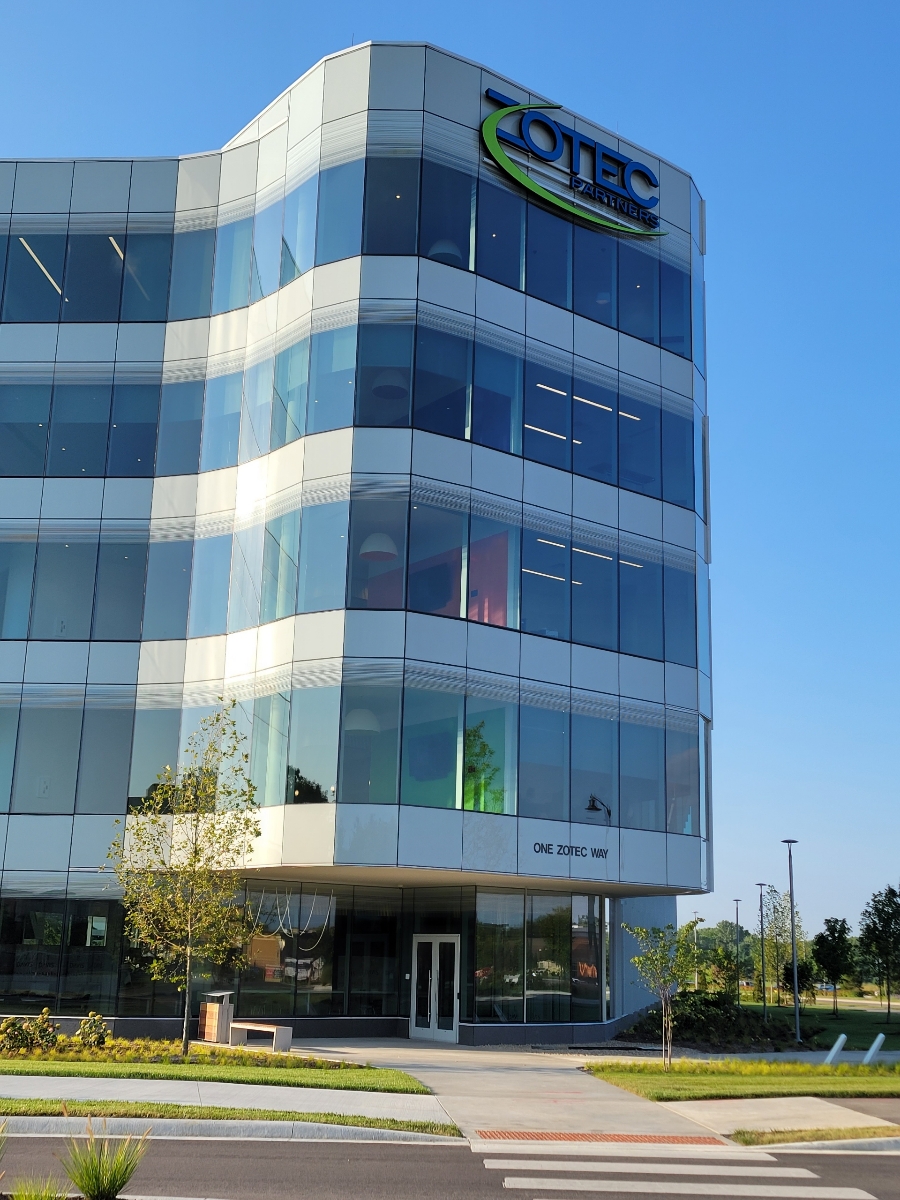
Relocation Strategies is currently assisting Zotec with move management to their new facility on N. Meridian in Indianapolis. Stay tuned for more!

3. Move + Change Management

Change management is critical to relieving stress and anxiety for employees, and any physical transition a company undertakes can be filled with obstacles. The amount of decision-making and planning required can exponentially increase with more square feet and staff members. We can help ensure that your relocation is the most cost-efficient with as little downtime as possible, along with helping to reduce employee stress when the workplace changes. Here’s how.
2. First Internet Bank (Nov. – Dec. 2021)

First Internet Bank move into a gorgeous new facility in Fishers! We’ve been diligently working with their staff over the past six months to create both a move and a change management plan that kept staff on task and employee engagement and culture top of mind. 

See a behind the scenes video of the new headquarters here

1. Reimagining workplaces for over 35 years

At the heart of everything we do, we are passionate about helping our clients reimagine their workplaces to be engaging and productive. We’re proud to have served clients for over 35 years and are excited to help more in the future.  

Follow along with our celebration on LinkedIn via the hashtag #Relois35. Thanks for being a part of our celebration! 

Ask ten people where they work these days, and you’ll probably get ten different answers. Some are back at their desks five days a week. Some haven’t set foot in an office building since 2020. Most are somewhere in the messy, flexible middle. 

A recent LinkedIn poll of our network put real numbers behind that mix: 65% of respondents said they work a hybrid schedule, 29% are back in the office full-time, and just 6% remain fully remote.

Hybrid has won, at least for now. But “hybrid” isn’t a single destination—it’s a spectrum, and every organization is finding its own place. The bigger question isn’t where your people are working; it’s whether the space they’re working in, wherever that is, is actually set up to help them do their best work. If the Great Resignation was the storm that shook up the workforce, plenty of companies are still living in its cloudy aftermath—what we like to call the Great Gloom: employees physically back in buildings that don’t reflect how they actually work anymore. Gray cubicles, disconnected teams, staff quietly quitting. That’s not just unfortunate—it’s avoidable, and it’s entirely a design problem.

Here’s how to think about optimizing your office no matter which environment—remote, hybrid, or fully in-person.

Modern workplace design

Where Are We Currently Working?

The return-to-office pendulum has swung hard over the past couple of years. Indiana Governor Mike Braun mandated that the state’s roughly 32,000 employees—a third of whom had been permitted to work at least part-time from home since the pandemic—return to the office five days a week back in 2025. 

Plenty of private employers have followed a similar path: 72% of companies, according to Deskbird, say they’ve seen increased revenue after implementing a return-to-office policy, and Zippia reports 68% of employers believe employees need to be in the office at least three days a week just to maintain company culture.

Employees see it differently. Zippia’s research found that 97% of workers want some form of remote work built into their schedule, and 68% actually prefer remote work over in-person.

Why Many Want to Work From Home

Did you know? A large part of why many people want to work from home is to save time (an average of 72 minutes per day) and an estimated $12,000 per year in costs such as transportation, food, and meals. (Source: 4 day week)

Why Many Want to Work From Home

Did you know? A large part of why many people want to work from home is to save time (an average of 72 minutes per day) and an estimated $12,000 per year in costs such as transportation, food, and meals. (Source: 4 day week)

That’s the tension nearly every leader is navigating right now: the business case for being together, weighed against a workforce that has gotten used to flexibility and isn’t eager to give it back. Forbes has gone so far as to predict that in 2026, remote work will increasingly be treated as a perk employers dangle to compete for talent, even as return-to-office mandates continue.

Here’s the thing—even when everyone is in the building, a huge share of the workday is still spent working alone. A Gensler survey of knowledge workers across six major U.S. cities with more than 100 staff found that people spend 48% of their time working independently, not collaboratively. We’ve seen a similar pattern in our own client data: in one recent Workplace Productivity Analysis®, 58.8% of employees reported spending eight or more hours at their assigned desk on an average workday, and of that time, 75% was spent on individual tasks versus just 25% collaborating.

So the real story isn’t remote versus hybrid versus in-office. No matter which model your organization lands on, the space itself has to flex to support both focused, individual work and genuine collaboration—often within the same afternoon, for the same person. A five-day mandate doesn’t automatically produce a productive office any more than a fully remote policy guarantees a happy one. What matters is whether the physical environment matches how people actually spend their time.

Building Community Without Losing Focus

The future of the office isn’t virtual reality—it’s community

Employees are prioritizing open communication and connection, and the organizations getting this right are designing spaces that make room for both togetherness and solitude. Small-scale conference rooms for four or five people, informal social hubs, huddle areas for quick collaboration—these spaces boost morale and give people a reason to be in the building, not just a reason they have to be.

This matters even more as Gen Z enters the workforce. Younger employees tend to place a higher value on connection and community than previous generations did, and a workplace that delivers a genuine “wow” on day one goes a long way toward attracting and keeping young talent. Collaborative workspaces encourage coworking and diverse perspectives, and they help build the communication skills and creativity that high-achieving organizations depend on.

But collaborative space is only half the equation. Just because community is having a moment doesn’t mean solo, quiet space should get pushed to the margins—introverted staff and heads-down workers need real estate too, and giving employees a genuine choice between the two is what actually drives productivity and well-being. That’s where an idea like reservable offices earns its keep.

Biggest Reasons Employees Like Going to the Office

Employees don’t necessarily want to eliminate the office. According to Gallup, the biggest reasons hybrid employees value going into the office are:

  • 55% — spending time with coworkers and building relationships
  • 44% — having conversations with their manager
  • 43% — collaborating with coworkers
  • 41% — having fun/socializing with employees
  • 35% — feeling part of the workplace culture

Biggest Reasons Employees Like Going to the Office

Employees don’t necessarily want to eliminate the office. According to Gallup, the biggest reasons hybrid employees value going into the office are:

  • 55% — spending time with coworkers and building relationships
  • 44% — having conversations with their manager
  • 43% — collaborating with coworkers
  • 41% — having fun/socializing with employees
  • 35% — feeling part of the workplace culture

Rather than assigning permanent desks that sit empty two or three days a week, or throwing everyone into an unassigned open floor plan, reservable spaces let people choose the environment that matches what they’re doing that day. The problem they solve is a real one: in an open-concept office with no assigned seating, employees waste an average of 19 minutes just deciding where to sit. Multiply that across a team of even modest size, and you’re looking at real hours lost to indecision every single week.

Implementing reservable offices well takes a bit of planning. It helps to split your space into a mix of individual offices or desks and shared workspaces, then set clear guidelines for how and when hybrid employees can reserve them—for example, staff who come in three or more days a week might earn a named office, while those who come in less often reserve a desk from their phone or laptop. 

Communicate those guidelines in more than one place: a company-wide meeting, a written policy, and the employee handbook all reinforce the same expectations. It’s also worth including a genuine variety of seating rather than defaulting to rows of identical desks—some employees only want a spot to grab coffee or eat lunch with colleagues, which is exactly why social hubs have become so popular. Once the system is live, cross-checking reservations with badge or security data occasionally ensures the space is actually being used the way it was designed to be, so any underused offices can be reopened to someone who needs them.

The look and feel of that space matters just as much as its layout. Resimercial design—a blend of residential comfort and commercial functionality—has become one of the defining interior design trends of the last few years, and for good reason. The average worker will spend roughly 90,000 hours in the office over the course of their career. Earthy tones, comfortable seating, soft ambient lighting, plants, and a few homey textures aren’t just aesthetic choices; they help employees feel psychologically safe and comfortable, which heightens morale and well-being. It’s what makes an office feel like somewhere people actually want to be, not just somewhere they’re required to show up.

Why Employee Feedback is the Missing Piece

Here’s where a lot of workplace strategies go wrong: leadership makes design decisions based on assumptions, trends, or what worked at the last office, instead of asking the people who actually use the space every day. The data on what happens when you skip that step is pretty compelling.

According to Gallup, employees who feel engaged in their work are 18% more productive, which translates into a 23% increase in profitability for their companies. Forbes has found that companies with highly engaged employees are 21% more profitable and 17% more productive, while disengaged employees drag profitability down by 15%. As of 2026, 92% of employers say lost focus is the top productivity problem in the modern workplace—which tells you the problem usually isn’t ambition or effort. It’s the environment.

Meanwhile, 62% of managers believe their teams are actually more productive working remotely or in a hybrid model, and a recent Accruent survey of more than 8,400 workers found that 63% said having the option of remote work is what matters most to them in a job—with 56% saying they know someone who has quit or plans to quit specifically because of a return-to-office mandate. Companies that lean into hybrid and co-working models, rather than fighting the tide, have reduced real estate costs by up to 30%, once you factor in the utilities, cleaning, and security costs that come with maintaining underused square footage.

Productivity Differences Between Hybrid and In-Office

According to the National Bureau of Economic Research’s 2025 study of more than 150,000 U.S. firms, most firms did not report large productivity differences between working from home and working on-site.

Productivity Differences Between Hybrid and In-Office

According to the National Bureau of Economic Research’s 2025 study of more than 150,000 U.S. firms, most firms did not report large productivity differences between working from home and working on-site.

None of this means you should default to whatever employees say they want without a strategy. It means you should ask, systematically, before you make expensive design decisions—and ideally before a relocation, a redesign, a period of growth or downsizing, or any major organizational change, since each of those moments reshapes how people use a space in ways leadership can’t always see from the top.

That’s exactly what our proprietary Workplace Productivity Analysis® is built to do: a staff-wide survey with custom-designed questions, paired with one-on-one stakeholder meetings with department heads and leadership to understand logistical realities. We gather both quantitative data (the numbers) and qualitative insight (the “why” behind them), then combine all of it with our own design and industry expertise to make recommendations that are grounded in how your people actually work, not guessing.

Since we first developed the survey in 2011 for a global client, over 6,500 employees have taken it. It was registered with the U.S. Patent and Trademark Office in 2014, and we’ve used it with five global companies to help them reimagine their workplaces. Across the board, clients have reported a 25% increase in employee engagement and productivity after implementing our recommendations. Third-party analysis also has a credibility advantage here: employees tend to be more candid with an outside, protected channel than in an internal survey their own manager might see, which means the data you get back is more honest—and more useful for the decisions that follow.

The Real Challenges Facing Offices Today

Even with the best intentions, most offices are fighting the same handful of battles. Here’s what’s actually getting in the way of a productive workplace right now.

Noise is still the number one distraction. 

It sounds almost too simple, but workplace noise pollution affects the productivity and concentration of 69% of employees globally, and sounds made by other humans—conversations, phone calls, that one coworker who takes every call on speaker, as well as video calls at desks—are the most distracting kind. 

Research from the University of Arizona found the optimal office noise level sits around 50 decibels, roughly the volume of birdsong or light rain. Once a person’s concentration is interrupted, it can take up to 20 minutes to fully regain focus, and separate research from UC Irvine puts that number even higher, at around 23 minutes and 15 seconds. 

The effects go beyond lost productivity, too: studies have linked workplace noise to higher rates of high cholesterol and high blood pressure among employees, tying an environmental problem directly to physical health outcomes. 

The good news is that noise isn’t inherently bad—phones have to ring, meetings have to happen, collaboration requires conversation. 70% of workers say idle social chatter, not necessary business noise, is what most drains their focus. The fix isn’t eliminating noise; it’s giving it a designated place to happen so it doesn’t bleed into everyone else’s workday.

What Employees Would Choose

Pew Research Center surveyed workers whose jobs could be done from home. Among those who work in a hybrid environment, Pew reported:

  • 72% would choose hybrid
  • 24% would choose fully remote
  • Only a small percentage would choose primarily/all in-person work

What Employees Would Choose

Pew Research Center surveyed workers whose jobs could be done from home. Among those who work in a hybrid environment, Pew reported:

  • 72% would choose hybrid
  • 24% would choose fully remote
  • Only a small percentage would choose primarily/all in-person work

The return-to-office crunch is real, and it’s disruptive. 

If your organization is moving toward more in-person days, you may be facing full in-person attendance for the first time in years, and that comes with real adjustment costs. 

In a widely cited study by Office Interiors, 93% of workers reported being “often interrupted” at work, and 80% said those interruptions increased their stress. Being exposed to just one nearby conversation can make workers up to 66% less productive. If your space hasn’t hosted your full team in a while, expect noise disruption, seating crunches, and a learning curve as everyone re-acclimates—and plan for it rather than reacting to it after the fact. That planning should include isolated spaces for calls and one-on-ones, plus acoustic panels, sound masking, and carpet that measurably cut down on ambient noise.

Furniture waste is a bigger problem than most companies realize.

In the U.S. alone, we throw away more than 12 million tons of furniture every year—a figure that’s grown 450% since 1960. An estimated 80.1% of that ends up in a landfill rather than being reused or recycled, and separate EPA research puts total office assets sent to landfills at roughly 17 billion pounds annually. Most companies replace their office furniture every five to ten years, which means there’s a constant cycle of usable furniture being discarded simply because nobody had a system in place for reusing it.

Underused space is quietly expensive. 

Whether it’s assigned desks sitting empty three days a week or an entire floor no one uses anymore, unoccupied square footage still costs money in utilities, cleaning, and security—costs that add up fast and rarely show up on anyone’s radar until someone goes looking for them. That’s part of why the reservable-space model described above has caught on so widely: it’s as much a cost-control strategy as it is an employee-experience one.

Preparing Your Culture for Whatever’s Next

Design can fix a lot of things, but it can’t do the job alone. The organizations that navigate workplace change well—whether that’s a move to hybrid, a return-to-office mandate, or just a refresh of an aging space—treat culture and communication as part of the project, not an afterthought.

One of the most overlooked causes of workplace disengagement is a simple lack of purpose. When employees walk into a space that doesn’t seem to support their role, they start to feel aimless, and no amount of nice furniture fixes that on its own. The fix is intentional zoning: individual desks that ground people in focused work, huddle areas that support quick collaboration, and conference rooms built for real strategic alignment. Purposeful design sends a message before a single word is spoken: this space was built with you in mind. As our CEO, Melissa St. John, puts it, “When people feel like they have a place, they find their purpose again.”

That sense of belonging connects directly to psychological safety—the degree to which employees feel comfortable sharing ideas, asking questions, or admitting mistakes without fear of judgment. Workplaces that support psychological safety see measurably better engagement, trust, and even profitability. Space alone doesn’t create psychological safety, but the wrong space can absolutely undermine it, and the right one reinforces it—quiet rooms for a hard conversation, informal spaces where hierarchy softens a bit, sightlines that don’t make anyone feel like they’re on display.

Change itself also needs to be managed deliberately. Even well-intentioned workplace upgrades create stress if they’re sprung on staff without a plan. That means building a real communications strategy around any transition: a clear milestone plan, workplace etiquette guidelines for anything new (like reservable offices), and on-site support during the actual move or renovation so day-to-day operations don’t grind to a halt. Culture readiness isn’t a separate initiative from your design project—it’s the thing that determines whether your design project actually works once the furniture is in place and the paint has dried.

Hybrid Increases Productivity

CIPD research reported that 41% of employers said increased hybrid working had increased productivity or efficiency, while 16% said it had decreased productivity or efficiency. 

They also found that approximately 1.1 million workers had left a job in the prior year due to lack of flexibility.

Hybrid Increases Productivity

CIPD research reported that 41% of employers said increased hybrid working had increased productivity or efficiency, while 16% said it had decreased productivity or efficiency. 

They also found that approximately 1.1 million workers had left a job in the prior year due to lack of flexibility.

What to Do in Today’s Environment

So what does all of this add up to? A few concrete moves.

Start by treating furniture reuse as a strategy, not an afterthought. “One man’s trash is another man’s treasure” might be a cliché, but it holds up: repurposing existing furniture is one of the fastest ways to refresh a space without blowing the budget, and it keeps usable pieces out of the waste stream. 

We recently helped a large university client save $8 million by reusing 200,000 square feet of furniture. On the inventory side, we’ve applied that same approach at scale: cataloging roughly 800,000 square feet across 49 schools for one school system, and 200,000 square feet for a hospital system’s mother and infant building, in both cases identifying exactly what could be reused before a single new item was ordered.

Our proprietary I.D.E.A.® software makes this possible: it catalogs furniture, fixtures, and equipment by photographing, sizing, and grading each piece (A, C, or F) so you know exactly what’s worth keeping, what should be donated, and what needs to be replaced. Reusing just 25,000 square feet of furniture has been shown to save organizations upward of $1 million, and it comes with a genuine environmental upside—less demand for the timber, metals, plastics, and fabrics that go into new furniture, and less carbon emitted in manufacturing and disposal.

Beyond furniture, think about the practical fixes that address the challenges above directly: acoustic panels, sound masking, and carpet to bring noise down toward that 50-decibel sweet spot; reservable spaces and a genuine mix of collaborative and quiet zones so employees aren’t stuck choosing between “productive” and “connected”; resimercial touches that make the office feel less like a cubicle farm and more like somewhere worth the commute; and a phased, well-communicated plan for any physical transition so your team’s day-to-day operations don’t suffer while the space evolves around them.

Most of all, don’t guess. Every lever covered here—collaborative space, noise management, sustainability, culture, layout—works best when it’s grounded in what your specific team actually needs, not a generic best-practice checklist borrowed from a different company with a different culture and a different building. That’s the difference between a refresh that looks good in photos and one that actually moves the needle on engagement and productivity.

Ready to Find Out What Your Team Actually Needs?

Every organization mentioned in this piece started in the same place: not knowing exactly what was working in their space and what wasn’t. Our Workplace Productivity Analysis® gives your employees a protected voice, gathers real data on how your space is being used, and turns it into a tailored plan—one that’s already shown to increase engagement and productivity by 25% for the clients we’ve worked with.

Whatever mix of remote, hybrid, and in-office your organization lands on, your space should be working just as hard as your people are. Learn more about the Workplace Productivity Analysis®, or reach out today to set up a consultation.

Increase Employee Engagement by 25%

Everyone works differently and your workspace matters! Reimagine your workspace into a flexible, engaging work environment that suits the needs of all of your employees.